Webhooks
Receive signed events from Volatilis GRC at your own HTTPS endpoint, verify them and handle retries.
A webhook sends a signed POST to your endpoint when something happens in Volatilis GRC, for example when a risk is created or a contract changes. You can create webhooks in the app or through the API.
Role needed
Create a webhook
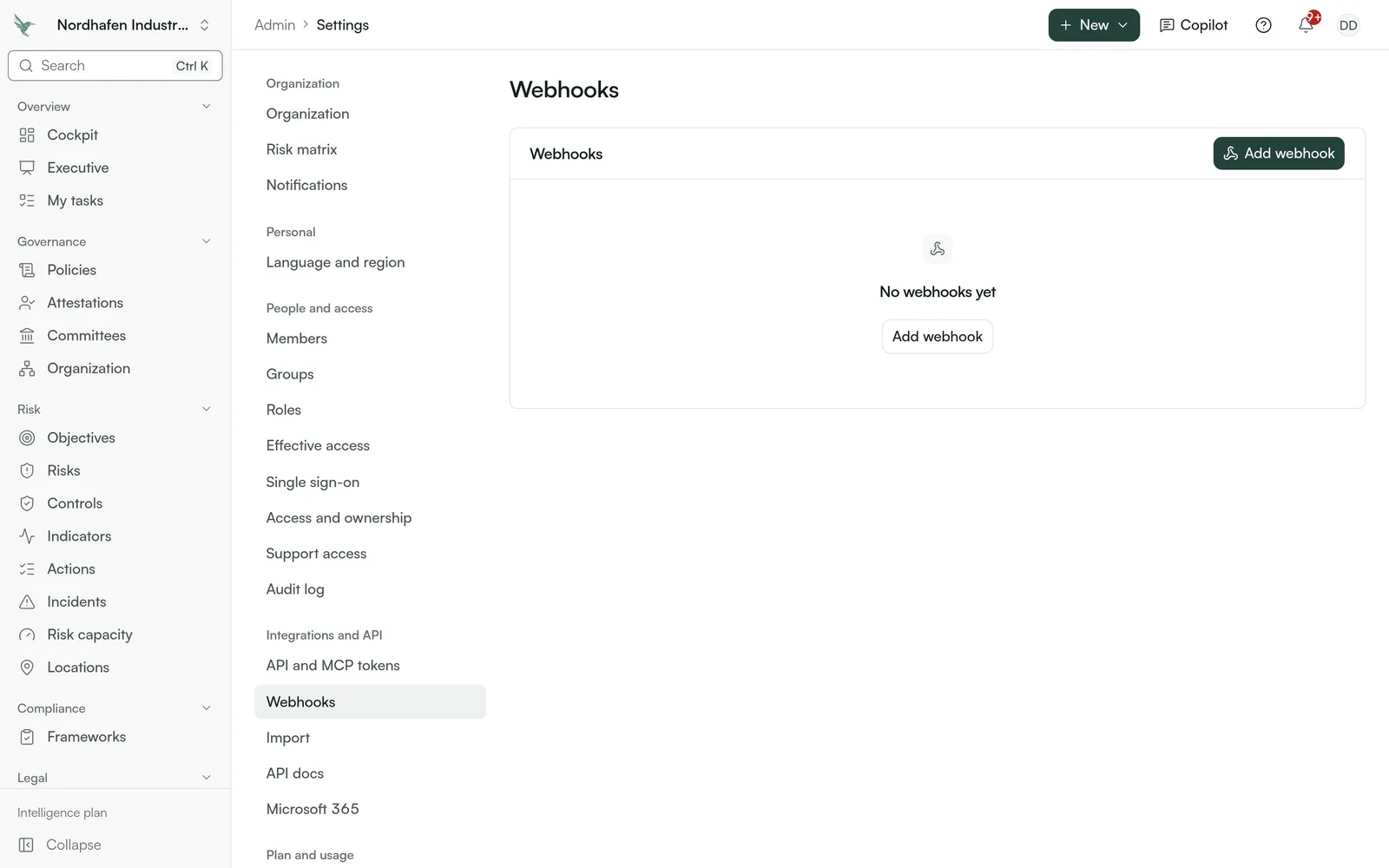
Open Settings, Webhooks and choose Add webhook.
Enter the Endpoint URL. It must be https and reachable from the internet. Private, loopback and link-local addresses are refused.
Choose the Events. The list is on the events reference. You can only pick events whose records you may view.
Choose create and copy the signing secret now. It is shown once and cannot be recovered. Your endpoint uses it to check the Volatilis-Signature header.
Choose Test. Volatilis GRC sends a webhook.test event once and shows the result. Check your endpoint received it and the signature matched.
An organization can have up to 20 webhooks.
Through the API:
curl -X POST https://grc.volatilis.org/api/v1/webhooks \
  -H "Authorization: Bearer vgrc_YOUR_TOKEN" \
  -H "Content-Type: application/json" \
  -d '{
    "url": "https://example.com/hooks/volatilis",
    "events": ["risk.created", "contract.updated"],
    "description": "ERP sync"
  }'
The answer has status 201 and carries the webhook with its secret. The secret is only in this answer. The token needs the write scope and an owner with the administrator right for Settings.
What you receive
A JSON body, sent as POST with a 10 second timeout:
{
  "id": "evt_5f0c...",
  "type": "risk.updated",
  "created_at": "2026-11-15T09:30:12.000Z",
  "org_id": "0b1f...",
  "data": {
    "entity": "risk",
    "id": "8e21...",
    "risk_id": "8e21...",
    "code": "R-014",
    "title": "Supplier outage",
    "category": "operational",
    "status": "open",
    "owner_email": "lena.hartmann@nordhafen.example",
    "owner_name": "Lena Hartmann",
    "residual_score": 12,
    "org_unit_id": null
  }
}
data depends on the event. Every record event carries entity and id. Use the id to read the full record through the REST API.
Headers:
| Header | Content |
|---|---|
Volatilis-Event-Id | The event id. The same id is used for every retry, so use it to ignore duplicates. |
Volatilis-Timestamp | Unix time in seconds when this attempt was signed. |
Volatilis-Signature | v1= followed by the hex HMAC-SHA256 of timestamp + "." + raw body, keyed with the secret. |
User-Agent | Volatilis-Webhooks/1 |
Verify the signature
Always verify before you trust a delivery. Use the raw request body, not a parsed and re-serialized one.
Read Volatilis-Timestamp and reject the request if it is more than 5 minutes away from your clock.
Compute the HMAC-SHA256 of the timestamp, a dot and the raw body with your signing secret. Write it as lowercase hex.
Compare it with every v1= value in Volatilis-Signature, in constant time. Accept if any matches.
import { createHmac, timingSafeEqual } from "node:crypto";

export function verify(secret, signatureHeader, timestamp, rawBody) {
  if (Math.abs(Date.now() / 1000 - Number(timestamp)) > 300) return false;
  const want = createHmac("sha256", secret).update(`${timestamp}.${rawBody}`).digest();
  return signatureHeader.split(",").some((part) => {
    const m = /^\s*v1=([0-9a-f]{64})\s*$/.exec(part);
    return m !== null && timingSafeEqual(Buffer.from(m[1], "hex"), want);
  });
}
Answer with any 2xx status as soon as you have stored the event. Do the slow work afterwards.
Retries and switching off
- A 2xx answer is success. Anything else, a timeout or a connection error is a failure.
- A failed delivery is retried up to 8 times, after 1 minute, 5 minutes, 15 minutes, 1 hour, 3 hours, 6 hours, 12 hours and 12 hours.
- A webhook that fails continuously for 3 days is switched off. The person who owns it gets a notification. Status Disabled shows the reason. Fix the endpoint, then resume the webhook (Resume in the app, or
PATCHwith"status": "active"). - An address that is refused (not public, not https, does not resolve) is not retried.
- Choose Pause to stop deliveries for a while, and Resume to start them again.
- The Test event is sent once and never retried.
Each delivery has a status: Delivered, Pending, Failed or Skipped. Choose Deliveries to see Recent deliveries with the HTTP code, the number of attempts and the reason for a skipped one. Through the API, use GET /api/v1/webhooks/{id}/deliveries.
To send a past delivery again, choose Redeliver next to it, or call POST /api/v1/webhooks/{id}/deliveries/{deliveryId}/redeliver. It sends the same event (same event id and body) as a new delivery with a new timestamp and signature, listed as a resend of the original. It needs the settings administrator right and an active webhook (a paused or disabled one refuses), and counts as a write for rate limits. It is not available over MCP. Your receiver should treat a repeated event id as a repeat.
Who receives what
A webhook belongs to the person who created it. At every attempt Volatilis GRC checks that this person may still view the record. If not, the delivery is skipped and the reason is logged. A webhook can never send more than its owner can read in the app. When the owner is deactivated or suspended, is blocked by the organization's SSO enforcement, or the organization is suspended or in its deletion window, deliveries are skipped. Queued imports follow the same rule.
Deliveries count as automation runs in your plan. When the monthly allowance is used up, deliveries are skipped until the month ends.
Webhooks need Intelligence or Tailored. On Foundation, creating, changing, testing, rotating and redelivering answer 402; listing, reading deliveries, pausing (PATCH with status: "paused") and deleting keep working; resuming needs the plan again. Deliveries of an organization that returned to Foundation are skipped with skip_reason "Webhooks are part of Intelligence.".
Rotate the secret
Choose Rotate secret in the app, or call POST /api/v1/webhooks/{id}/rotate-secret. The new secret is shown once.
For the next 24 hours every delivery carries two signatures: v1=<new>,v1=<old>. Your verification accepts either.
Switch your endpoint to the new secret within that day. After 24 hours only the new secret signs.
Endpoints
The reference lists GET /webhook-events, GET and POST /webhooks, GET, PATCH and DELETE /webhooks/{id}, POST /webhooks/{id}/rotate-secret, POST /webhooks/{id}/test (needs an Idempotency-Key) and GET /webhooks/{id}/deliveries. See the API reference. GET /webhooks/{id} returns an ETag; PATCH and DELETE /webhooks/{id} need it as If-Match, like every other record: 428 without it, 412 with the current ETag when the webhook changed since you read it (see REST conventions). Deleting a webhook also deletes its delivery log.